From “All My Guitars,” a work in progress
How big should a guitar be?
This might seem like an esoteric question. But it plagued me for many years.
The first guitar that I met belonged to my father, Manny Greenhill. It was a small nylon-string instrument. Did he play it while taking lessons from the great Josh White? Did he take it to Honolulu when he served there, during World War II? I never thought to ask.

I didn’t get serious about the instrument until my early teens. My dad’s quirky idea, to present Pete Seeger in concert at Jordan Hall, started it all.
In retrospect, it seems an unlikely choice. Jordan Hall, in Boston’s Fenway neighborhood, was home to the august New England Conservatory of Music. Chamber music and bel canto recitals were the venue’s normal offerings. And this was 1957, the height of the blacklist, when many in the performing arts, both presenters and concert-goers, were actively avoiding Pete and other left-leaning artists. Today we’d say they were “canceled.” In a sign of the times, the FBI approached Manny at his local trolley station and asked why he was presenting a “known communist.” My dad shrugged and noted, “He sells tickets.”

The concert was a success, financially as well as artistically. That was important to me, but not nearly as important as getting to know Pete and his sidekick, harmonica virtuoso Sonny Terry. In those more casual times, the two of them didn’t stay at a hotel; they stayed at our house in Dorchester. In the aftermath of their visit, I became obsessed with the banjo, Pete’s main instrument. Played it – or rather, played at it – for hours in my bedroom. Scared the family dog, as well as some of the neighbors.
My parents were relieved when, the next year, I turned my attention to the less intrusive guitar. This was largely due to another charismatic house guest, Rolf Cahn. When Rolf arrived from California, he bunked in at our place for what was supposed to be a short stay. When it lengthened, my parents put him to work giving me guitar lessons.
Rolf was a German Jew with a precise, theoretical approach to everything, including guitar lessons. He would break down Sister Rosetta Tharpe’s lead lines, and then drill me on them as if I were in some sort of musical boot camp. He came with a complicated back story – Rolf had served time in prison, where he had learned the manly art of boxing. Earlier, rumor had it, he had spent much of the war behind enemy lines, working for the Resistance, perhaps blowing things up. In later years he would publish a book, Self Defense for Gentle People.
Rolf quickly became my blues guru, along with his musical companion Eric von Schmidt. They were an unlikely pair: while Rolf was highly theoretical and rules-based, Eric was more of a follow-your-bliss kind of soul. But they shared a sense that life should be an artistic pursuit, each and every day.

Playing my Gibson J-45 behind Rolf Cahn and Eric von Schmidt at Club 47, Cambridge
Rolf was my teacher, but Eric became my role model. One look at his Gibson J-45, a good deal bigger than Manny’s nylon-string job, was all it took to convince me; that guitar was the one for me. And when my household chores expanded to include driving new guest Lightnin’ Hopkins to a series of New England performances, the deal was sealed — Lightnin’ too played a Gibson.
The J-45 seemed plenty big. But Gibson made an even larger model, the J-200. That guitar became the constant companion of yet another visitor from the strange musical outer world, Reverend Gary Davis. He latched onto the enormous instrument at Wurlitzer’s Music in downtown Boston, wouldn’t let it out of his grasp. Finally, at the reverend’s insistence, the proprietor called my dad. “He’s good for it,” said Davis reassuringly, with an implied wink. True to the minister’s word, Manny coughed up the 500 bucks, and soon Reverend Davis was playing “Miss Gibson” on our living room couch. He still wouldn’t let it out of his hands. When you’re blind, you learn to take such precautions.

Reverend Davis and his mighty Gibson J-200. Photo by Stefan Grossman.
Perhaps the J-200 inspired me to up my game. When I began to play behind Jackie Washington (aka Jack Landrón), I replaced the J-45 with a still bigger guitar. My dad first heard Jack perform an off-the-cuff set at the Golden Vanity, a local coffee house. He recognized the talent and charisma but saw that Jack’s guitar chops needed some work. After I was recruited to address the matter, I became Jack’s accompanist, and he became my new role model. We played all over the East Coast, including the Newport Folk Festival, the Second Fret in Philadelphia, and that same Jordan Hall in Boston. Jack was playing a Martin Dreadnought; I played a Guild, the biggest guitar I had ever owned.

Playing my Guild behind Jackie Washington at Jordan Hall, Boston.
As I played behind my mentors and role models, I was simultaneously developing the beginnings of a solo performance. Sometimes – at the Coffee Gallery in Detroit, for example – I would serve as Jack’s opening act, as well as his accompanist. Along the way, I was beginning to feel that a hefty guitar, like the Guild, was too generic, not specific enough. Everybody was playing big guitars and I wanted to be different. So one day – I think it was during a two-week stretch at the Second Fret – I wandered into a local music shop and fell in love with a petite and tidy Gibson L-1. I decided it was time to downsize.
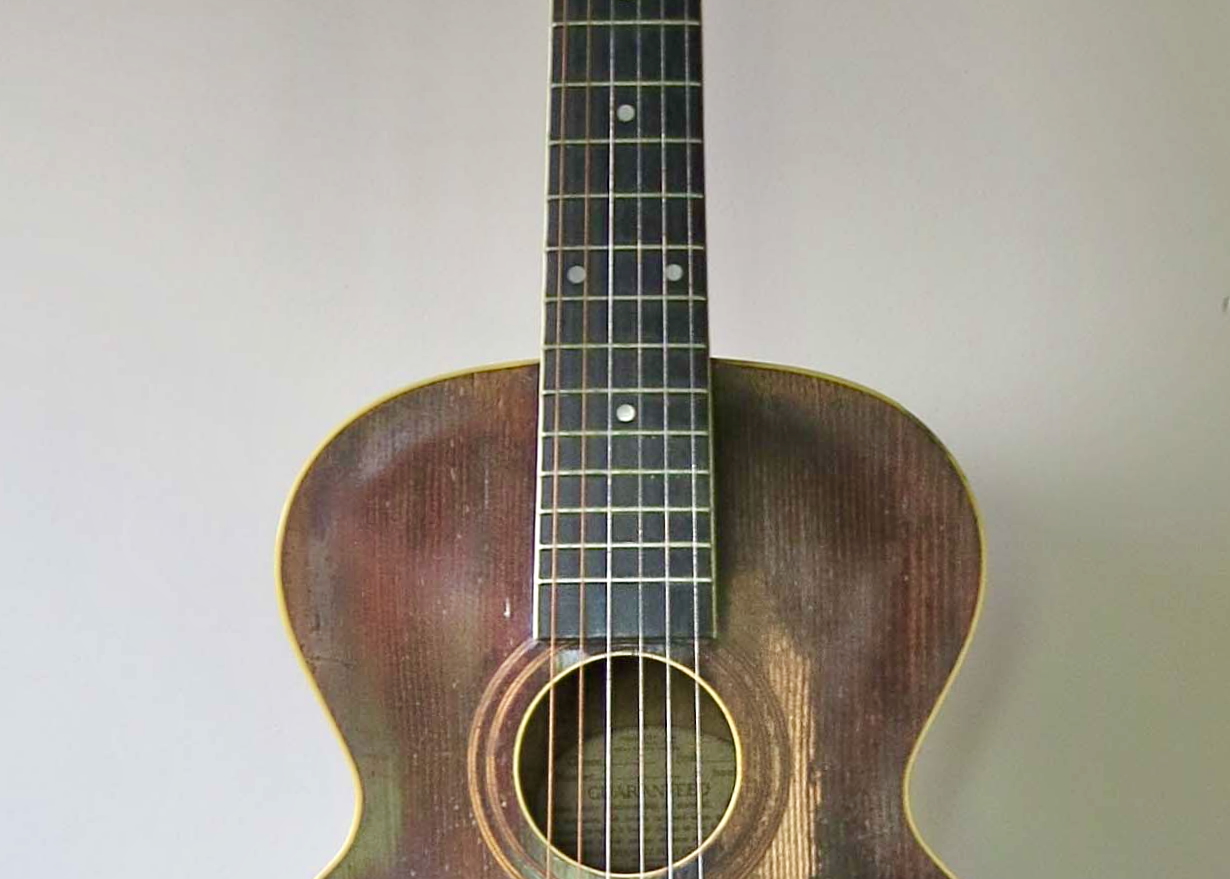
Here was a guitar, made back in 1914, that a country blues hero like Mississippi John Hurt might play. Quirky, one-of-a-kind, an arch-top. Nobody else on the folk music circuit was playing anything like it. For the rest of the 1960s, this Gibson L-1 became my main squeeze, my signature axe. I played it at the Newport Folk Festival and on my two albums for Prestige Records.

Playing the Gibson L-1 at the Newport Folk Festival, 1966
The L-1 accompanied my move to California, where I played it at the Berkeley Folk Festival. And at the San Diego Folk Festival, where I met Mayne Smith, with whom I made music for the next 57 years. When Mayne and I teamed up with Mark Spoelstra to create The Frontier Constabulary and I began to explore the electric guitar, this was still my main acoustic instrument.

And at the Berkeley Folk Festival, 1968. Photo by Barry Olivier.
When Mark left, Mayne and I stayed with our rhythm section and continued as The Frontier. I was still playing this small Gibson on our acoustic sets. At one point, it fell off a stage and the peghead broke. I had it repaired and soldiered on. At another point, someone stole it from my two-room shack in Sonoma County, California. Bandmate Lee Poundstone, who occasionally moved on the shady side of town, tracked it down and had it returned, no questions asked.

With Mayne Smith and the Gibson L-1 at the Sweets Mill Music Camp.
Mayne Smith was basically a bluegrass player. And bluegrass players are known to play big Martin Dreadnought guitars. Mayne’s was a pre-war D-28, a beautiful instrument, with a spruce top and mahogany back and sides, loud enough to be heard in any bluegrass jam session. Under his influence – and, truth be told, needing a louder instrument myself – I drifted into the Dreadnought world and acquired a Martin D-21, with its distinctive two-piece rosewood back. For me at this time, big was back.
I played the D-21 for a couple of years, but we never really connected. It, as well as the other Dreadnoughts, was too boomy for my style, which has a sweet spot about halfway up the guitar neck. Mayne agreed with this analysis, so one day we walked from his Oakland apartment down to Leo’s Pro Audio on Telegraph Avenue. As Mayne listened, I played a number of guitars and finally settled on the midsize Martin M-38 that remains my go-to instrument.
I sold the D-21 to my dentist. When I asked him to throw in a gram of cocaine – don’t dentists always have access to cocaine? – he demurred.
The Martin M-38 – which the company no longer makes – has a history. In the 1930s, Martin, always known for flat-top guitars, decided to try to break into the jazz market by creating an arch-top. Instead of a single sound hole, the top featured two f-holes. The strings sat on a floating bridge and were anchored by a metal tailpiece (like my L-1) instead of a saddle.

Martin never did break into the jazz market, and the arch-top guitar went nowhere, until a few enterprising souls — including David Bromberg, Mark Silber and Matt Umanov — had the bright idea to scrap the arch-top and rework the instrument as a flat-top. This instrument, which proved perfect for my needs, is less deep than the Dreadnought. Its hips are about the same width, but the bust is smaller. And the back retains the slight curve of its arch-top ancestor. For me, the M-38’s crucial quality is its perfect balance between bass, treble and mid-range. That’s what works for me.

Playing my Martin M-38 at Merlefest. Photo by Jim Gavenus. Jody Call on percussion.
A guitar’s size certainly affects its volume and its tone. Of course, one size never fits all. Finding the right size for the player, the right tool for the job, is every guitarist’s goal. I’ve found the right instrument for me and I’m not looking any further.
But every now and then, I wonder — if only the M-38 featured a cutaway, so that I could grab those high frets more easily, if only the neck were 1/32 of an inch wider, if only…
A solo guitar piece, played on my Martin M-38