
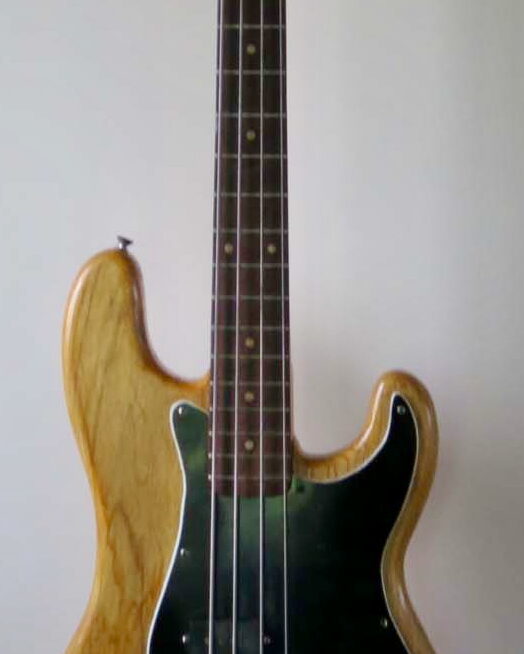
From “All My Guitars,” a work in progress
It was the glitter that got me.
White sparkles popped out of a green background that could have been right at home in a tacky motel that rents rooms by the hour.
But still, it was a 1959 Fender Precision bass. I had been seeking a P-bass ever since my band broke up and I no longer had occasional picking privileges to Texas Lee Poundstone’s white one. He played it upside down, as it had originally been designed for a left-handed player. I guess that was why it was marked down to something he could afford. The glitter was probably why I could afford this one, listed at $175.00. These were 1974 dollars, but still something that I could handle.
Reader, I bought it.
It played and sounded great! That, of course, is what sealed the deal. My fingers slid across the rosewood fingerboard like a hot knife through butter. The instrument’s signature transients, the attack from my fingers, gave a perfect introduction and shape to the deep tones that followed, the dark bottom end of a musical passage.
But that glitter! Had it been ten years later, when retro was all the rage, I probably would have kept the sparkles and proudly owned the tackiness. But back then my musical community, a rural, back-to-nature enclave about 90 minutes north of this San Francisco music store, esteemed the pure and the unadorned.
So I got to work paring the instrument down to its essence. The P-bass is a simple creature, basically a slab of ash, attached to a maple neck by four bolts. By 1959 that rosewood fingerboard had been a radical innovation. I would have preferred the solid maple neck of earlier models. Then it would have mirrored the neck on my Fender Telecaster guitar, which dated from 1957. But hey, you can’t have everything.
I loosened the strings and counter-clockwise turned the screws that peeked through a small metal plate with its signature “F” logo. My new instrument was now in two pieces that I held in both hands, the strings dangling from its neck.
Putting the neck aside, I turned my attention to the garishly painted body. First to go were the volume and tone knobs, as well as the pick guard. I was now looking at a simple, albeit lurid, slab of wood. I remember applying some sort of chemical paint stripper. I would brush on a coat and let the mysterious concoction interact with the paint until it bubbled like some sort of demonic science experiment. After each coat I would sand the body down. I think I may have tested a stain, before abandoning that idea.
The sparkles departed fairly quickly. But the sickly motel green paint was reluctant to leave the grains where it had taken up deep residence. After a number of attempts, I resigned myself to living with the residue of the instrument’s past life. And now, half a century later, I can barely see any of it.
At the time, my purchase of the P-bass was an investment in a future that was all hope and no reality. I had played bass in some jam sessions, but never in public and never in performance. Guitar was the instrument that I knew how to play and the basis of all my gigs. But I could hear bass lines, and at times I was frustrated when my bass players couldn’t or wouldn’t play what I was hearing. I had written out some bass parts, but at the time I ran across few bass players who could read music well; and the ones that could, preferred to create their own parts.
For several years, the instrument sat in my closet, gathering dust. But in 1979, my partner Mayne Smith and I secured an album deal with Bay Records. This was my chance. I blew off the dust and began to woodshed on the bass.
Mayne and I eventually released three albums, two of which were recorded live, direct-to-tape, with no overdubs. But the eight tracks on this first album, which we called Storm Coming, were created slowly, over several months, layer by layer.
The initial sessions focused on drummer Scott Matthews. Mayne and I would sing and play guitar, scratch tracks to be replaced later. But Scott’s drum tracks were keepers, the foundation upon which the rest of the album would be constructed. Fortunately, Scott was a great drummer, and we never had occasion to question his choices.
This proved crucial when it came time for me to lay down the electric bass parts. As I’ve indicated, I was comfortable on the instrument and had some definite ideas about how it should function in the songs. But I hadn’t played a lot of bass, and this context put me on the spot. As Mayne Smith and engineer Michael Cogan peered into the studio from the control room, I wondered — could I deliver? Thanks largely to Scott’s solid bedrock substructure, I found that I could.
I loved laying down those tracks. I asked Michael to boost Scott’s kick drum in my headphones. That was my rock, and I tried to land my downbeat solidly with Scott’s right foot. Once that was in place, I felt free to add melodic embellishments. On “Freight Train Blues,” the bass line anchored horn parts that I wrote later. On “Storm Coming,” the album’s title song, I goosed the chorus along with syncopation that drew from my bass heroes, James Jamerson and Jerry Jemmott. Before too long, I felt that, although the journey had just begun, yes, I was now a bona fide bass player, holding down the bottom end.
Some months later, the album was released, and I was driving Doc & Merle Watson and their bass player, T. Michael Coleman to a gig. By then I had moved over to the Business side of the Music Business, and Doc and Merle, whom I had admired for years, were my most valued associates. Both had generously contributed tracks to our album, including Merle’s slide guitar that countered the horns on “Freight Train Blues.” I took the occasion to slide a tape into the car’s cassette player and play them the results. Doc grunted and allowed, “It’s a good album.” I think Merle was asleep.
But Michael paid attention, and some months later, when he requested to be excused from a tour while awaiting the birth of a child, he recommended me as a substitute. Those gigs in Arizona and New Mexico provided my first occasion to play with the Watsons. It was always a wonderful and inspiring experience, one that never grew old. In years to come, I would play with them, on guitar or bass, often — at the Newport Folk Festival, for example, and at Merlefest, the gathering created in Merle’s honor after he passed.

Playing with Doc & Merle, Flagstaff, AZ, maybe 1980
The P-bass has stayed close to me for many years and is still a dear companion. I’ve played it on gigs and recordings, not only my own, but also behind artists like Rosalie Sorrels and Mary McCaslin. Only on this instrument can I express a certain side of my music, one that is grounded in rhythm while keeping interesting melodic ideas in the mix. At the risk of getting too deep into the weeds, my bass line on Rosalie’s recording of “Hitchhiker in the Rain” mixes a pedal-point drone with a major seventh. It’s an unusual choice, but one that I feel supports this bitter-sweet ode to Rosalie’s dead son, whom I knew pretty well.
These days my home studio hosts most of my recording. The P-bass lives in the room’s closet. But every now and then, including at Merlefest in Western North Carolina, I bring the instrument out and hand it to Peter Spelman, who plays bass with my current band, Mitch’s Kitchen. Peter loves the instrument and plays it beautifully.
Doc and Merle and Rosalie have passed. Leo Fender is long gone. But his quirky, deceptively simply invention still plays great.

Discussion about this post