
New Years Day, 1988. As I approached my fourteenth year with Folklore Productions (now FLi Artists), I had probably booked a thousand gigs for the likes of Doc Watson, Taj Mahal and Dave Van Ronk. I hadn’t intended to stay this long in my father’s business. It was supposed to be a temporary stop on my journey to wherever, a way to help him get over the hump of Joan Baez’s departure and to help me get over the hump of my kids’ dental bills.
As the New Year dawned, I reflected that things had, in fact, developed better than expected. Even as I was learning how to book gigs and how to advise artists, I had managed to produce one Grammy Award winning record and several nominations. I had landed a movie gig in Walter Hills’s The Long Riders, under the musical direction of Ry Cooder. I was starting to achieve some recognition for my work as composer and sound designer for local theaters. So, as I balanced my own artistic ambitions with the need to help other artists realize theirs, a future at the Folklore desk was starting to seem like a plausible way to enter middle age.
But a sense of burnout lurked underneath all of my habits, all of my work life and all of my home life. All that was left of a home life, that is, after the painful end of my marriage. I felt the need to get away. Really away – to Europe, to Asia, to Africa. To places where phones didn’t ring, where gigs did not get canceled, and where artists did not miss flights.
In some ways, the timing seemed right. My father Manny Greenhill was still vibrant enough to handle most of the bookings, and my son Matt was old enough to apprentice with the old man and to begin learning the business. And the marriage that no longer existed seemed to provide an open door to the outer world.
But as I began to assemble the elements for what I came to call my midlife crisis abroad, one problem stumped me. If I were to spend several months as a world traveler, what would become of my guitar chops? Would they wither away? I was ready for some big changes, but my identity as a guitar player – a way that I had defined myself, at least to myself, for over three decades – that was not up for debate.
Traveling with one of my valuable instruments – the 1980 Martin M-38 or the 1914 Gibson L-1 – was out of the question. I expected to be trudging through jungles and mountains. It was one thing to put myself into these questionable circumstances, but quite another to subject my fragile babies to such iffy conditions.
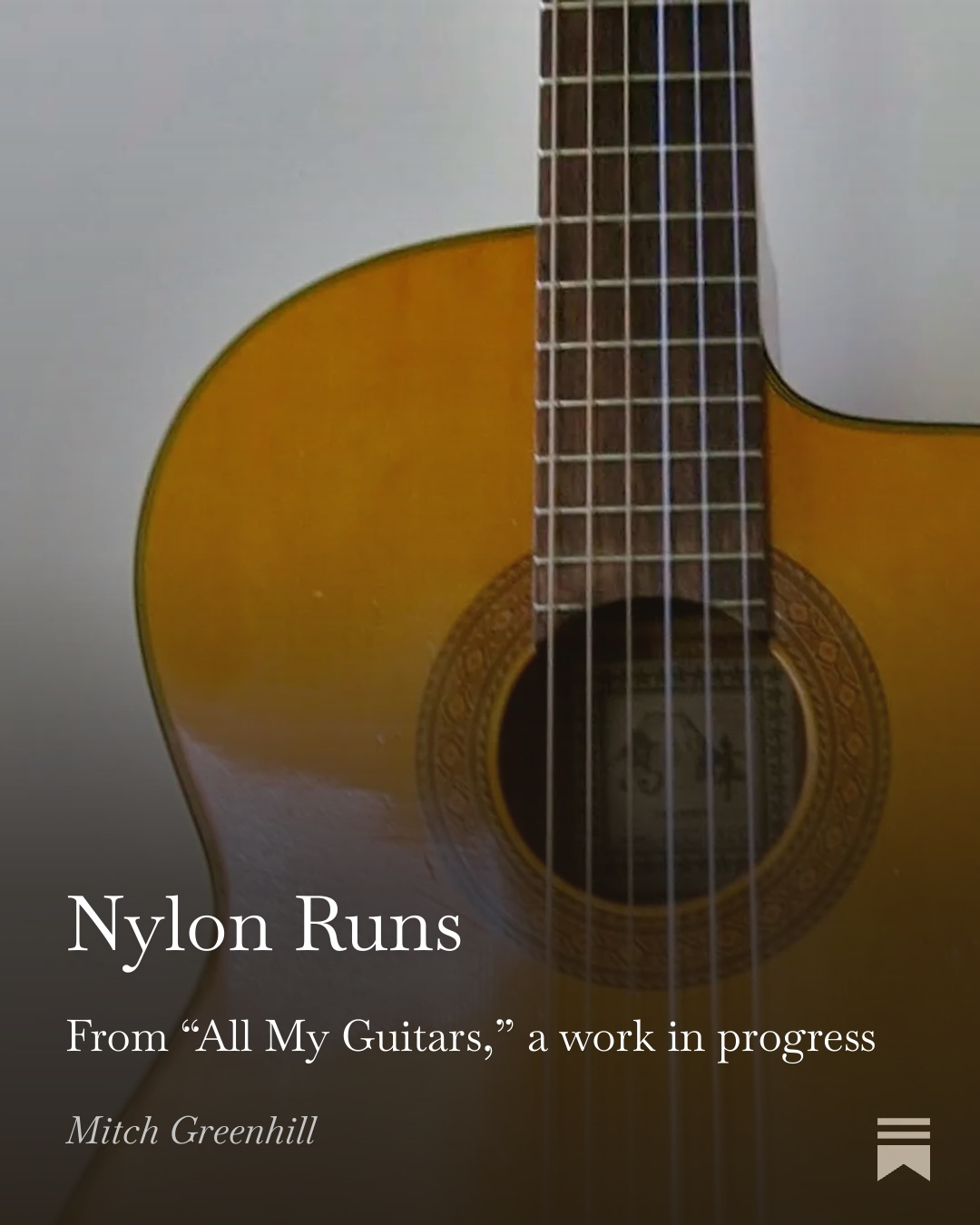
Considering the options, I decided that this could be an opportunity to learn my way around the nylon-string guitar, an instrument light enough to carry on my back in a soft gig bag. The new Takamini that I landed upon cost a few hundred dollars. While I would regret having the instrument lost, damaged or even stolen, that was a risk that I was prepared to assume.

In my early teens, as a new guitar student, I had taken some classical music lessons on nylon-string guitar from one Guy Simeone. Maestro Simeone had shown me some useful approaches to the fretboard, and it was good to get grounded in reading music notation for the instrument. But when he insisted that I abandon the steel-string guitar and my love for the blues, I bade him goodbye and stuck with my steel-string guru, Rolf Cahn. Now seemed a good time to return to the nylon and to approach it on my own terms. I would, for example, be playing it with either a thumb pick or a flat pick, blasphemy in the classical music world.
The Takamini proved a fortunate choice, a good and constant companion throughout my travels. In London I played it at a local folk club. In Bali, I gave an impromptu concert to other travelers. In Kathmandu, it helped woo a fair maiden. In Paris, it helped heal a broken heart.
But mostly it kept me company on the lonely nights that occasionally plague all solo travelers. I remember a long day’s journey that ended in Ko Phan-Ngan, an island off the coast of Southern Thailand – actually, an island off an island off the coast of Southern Thailand. Exhausted, I opened a bottle of the local beer, unzipped my guitar case, and played for a long time, as a waterspout played on the horizon.
When I embarked on the more challenging legs of my trip, I left the instrument in the care of inn keepers. So it was not on my back when I fell into the Lao River or when I was gasping for air at 13,000 feet in the Himalaya. And fortunately, the instrument was waiting for me when I returned to the various inns.
And when I did get robbed, a snatch-and-run job at the Delhi train station, the guitar stayed on my back and did not follow my shoulder bag off to parts unknown.
The Takamini nylon-string guitar is still with me, and I still play it regularly. Although I regularly protest that I am now on the road to retirement after 50 years, I still log in time at Folklore Productions. I have outlasted my father Manny, who died in the saddle, some 40 years after having founded the company. My son Matt, having recently turned 60, handles virtually all the bookings these days. His daughters have expressed some interest in assuming the mantle, but they’re still young; Matt and I did not get involved until we were in our early thirties.
Most of my guitars live in a locked closet. But this one hangs on the wall next to my bed. On those nights when musical ideas or questions interrupt my dreams, the nylon-string Takamini is the instrument I turn to. Half awake, I’ll pull it down and, sitting on my bed in my nightshirt, try to work my way through the musical questions that trouble my sleep. It’s then that I recall that, although this wooden object may not be the world’s greatest guitar, and although it is not my primary instrument, it is the one with whom I have traveled the longest journey. Sometimes “good enough” is “just right.”
