
by Mitch Greenhill
Jack Landrón stopped by the other night. Over a couple of libations, we picked up where we left off, a long riff on music, politics and aging. We’ve known each other for over 60 years, longer than some of our contemporaries survived. So there’s a minimum of chit-chat before we get down to cases.
Roberta and I had recently returned from a musical journey that began in Wilkesboro, North Carolina, where we performed at Merlefest, then continued southwest to the Mississippi Delta. It was a journey long deferred and long anticipated. I’ve been playing the blues since Rolf Cahn showed me the basics back in 1956 or ‘57. But I had never spent concentrated, quality time in the Delta, where the music originated.
We began in the state’s northwest corner. Clarksdale was heavy with memory. But it seemed a sad and broken town, struggling to turn its storied musical history into an attraction that might lure outsiders with a few bucks to spend. Among its points of interest, Clarksdale was advertising a highway intersection as the crossroads where Robert Johnson supposedly sold his soul to the devil in exchange for his magical musical gifts. But a little research revealed that this particular crossroads, where U.S. 49 meets U.S. 61, did not exist In Johnson’s day.
Farther south on Highway 61, Dockery Farm seemed to be doing a better, if more subtle, job of promoting and explaining its blues history. We were met by Tricia Walker, a local musician and friend of a friend. “Over there,” she said, “was the Frolickin’ House. Son House played there. Robert Johnson too. Probably Skip James.”
Squinting, I peered towards Frolickin’ House Hill, a low rise just beyond a shallow creek. I leaned a bit in its direction, as if trying to hear the music that must have enlivened a Saturday night in North Mississippi.
I could imagine the Frolickin’ House as playground of the blues gods. It evoked divine realms, like Mount Olympus or Valhalla. But Zeus, Thor, Wotan — the gods who strode through those heavenly realms — none of them could play a lick of blues. It was reassuring to think that, even among the deities, there’s room for improvement.
We followed Tricia down a dirt road. Here, she confidently asserted, is the real crossroads of Robert Johnson lore. And it did seem more plausible than the concrete intersection up in Clarksdale. Here, the dirt road from Dockery Farm crossed another one, parallel to Highway 61, now a mile behind us. And parallel to a nearby railroad track, also running north-south, at least at this point. But eventually, according to Tricia, connecting with the Yazoo & Mississippi Valley line and points north — like Grafton, Wisconsin, where Skip James recorded.
It was easy to imagine a host of blues gods hopping freight trains as they traveled to and from Dockery and its Frolickin’ House.
Was this really the place of transactions between the divine and the diabolic? I tried to open myself to any mystical negotiating vibes but came up empty. Then I remembered: it’s Tuesday, probably a dark night, when the devil takes a break. I contented myself by finding a stone or two that spoke to me.
A couple of hours later and some 90 miles farther south, Roberta and I entered the Blue Front Café in Bentonia, hometown of my blues hero Skip James. Back in the early 1960’s, my friends and I obsessed over this unique musician. We argued over the words to his song. We thrilled to his high keening voice and pondered the mystery of his guitar and piano stylings. We wondered where he had been all those years, and was he still alive? Then, at the 1964 Newport Folk Festival, on the weekend of Newport’s annual transition from high-society summer home to counter-culture campsite, Skip James lumbered out of the Rhode Island mists to join a blues workshop that was already populated by a number of the Frolickin’ House’s celestial beings. He sat down next to Son House and played and sang, and damn, he was as good as ever!
Skip went on to a brief career playing folk music coffee houses like the ones where Jack Landrón and I honed our chops. Far from Bentonia, Skip spent much of his later years in the New York jazz scene, where his quirky piano style intrigued uptown beboppers. In 1969, when Skip James died of cancer, he was in Pennsylvania, not Mississippi.
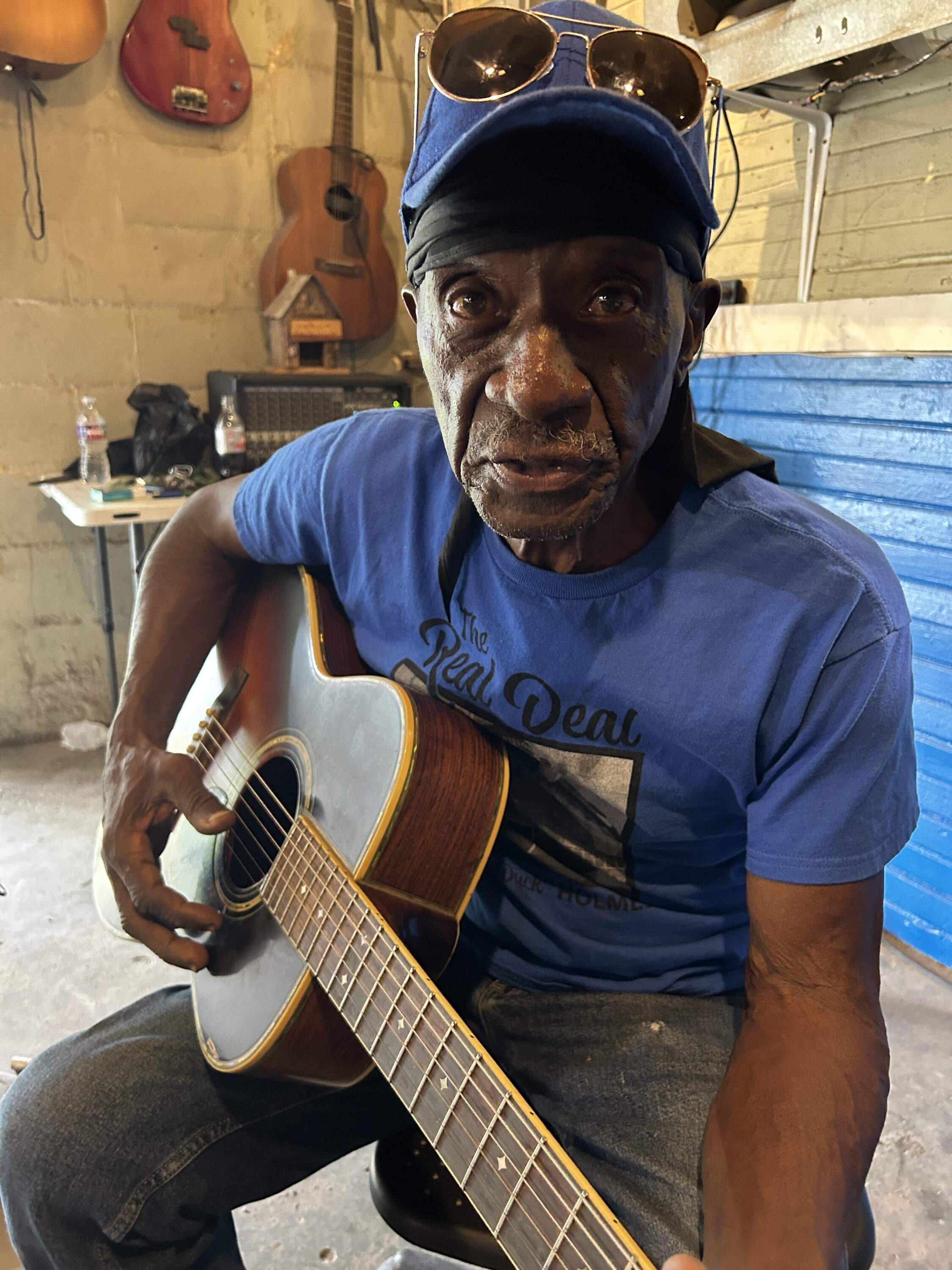
At the Blue Front Café, where he started, Jimmy “Duck” Holmes had just begun to show me the Bentonia guitar tuning — you tune the guitar to an open minor chord, but you play in a major key — when a train rumbled by. All activity, from conversation to music to ordering a pig’s foot and a bottle of beer, had to pause until it passed. Then our guitar lesson resumed. Jimmy, whose parents took over the room in 1948, assured me that Skip did really play here. So did his mentor Henry Stuckey, whose photo was displayed in a pace of honor, next to the juke box and several guitars. This then was the home of the fabled Bentonia School of Blues. I had been a bit skeptical that, if its graduates include only Skip James, Henry Stuckey and Jimmy “Duck” Holmes, can it really be a “school?” But since I was now face-to-face with possibly the academy’s only surviving scholar-professor, I decided not to debate the issue.
As I related these experiences to Jack, I tried to read his response. To him, an Afro-Puerto Rican from Boston’s Roxbury neighborhood, Mississippi was the scene of his work in the Civil Rights struggle. In 1964, Freedom Summer, he spent several months there including a stint as Rev. Martin Luther King’s personal assistant. (“His gofer, actually,” Jack recalls.) So while he was somewhat engaged with my blues journey, Jack’s interest picked up a notch with our subsequent visit to the Civil Rights Museum in Jackson, about an hour south of Bentonia. There we were met by a kindly docent. “The disease of Mississippi is the disease of America,” she informed us, a beaming smile spreading across her caramel face as her eyes drilled into Roberta’s and mine. “And until Mississippi has healed, America cannot heal.” Behind her, a list of lynching victims spread across several rooms.
“What is it about the blues that you like?” Jack finally asked me. He could understand why the blues would appeal to a slice of downtrodden non-persons; but why to a middle-class Jewish kid growing up in Boston?
“Not sure why,” I replied, “but from the first time I heard the music, it grabbed me. It got deep inside me, almost a spiritual experience. And I’ve been tied to it ever since. Maybe the blues showed me a way out of middle-class America.”
“Why?”
My mind went back to life in the Eisenhower years. “It was so boring.” In those confining times, I was a teenage seeker, for whom the blues offered an avenue into a world of mystery, love, and a deeper understanding of the world I was living in. And perhaps a glimpse into a shadow world churning beneath.
Then I turned the tables and asked Jack what was his “blue,” what music got inside him in that way?
Expecting something from his Black Puerto Rican heritage, I was surprised when he immediately cited traditional ballads. When I asked why, he referred to the language, the story-telling. He cited his version of “Nottamun Town,” an Anglo-American ballad that he first learned from the singing of Jean Ritchie. She was a Kentucky folksinger who came from a long line of ballad singers. Jack’s version upped the song’s intensity and probably formed the basis for Bob Dylan’s “Masters of War.”
Jack valued the song’s “surreal” lyrics:
In Nottamun Town, not a soul would look up
Not a soul would look up Not a soul would look down…
To show me the way to fair Nottamun Town
As the song continues, we meet “a stark naked drummer A-beating the drum.” Eventually the narrator sits down on a “hard cold frozen stone” as “Ten thousand got drownded that never was born.”
That got me thinking about mysterious blues lines, like Skip James’s
I’d rather be the devil than be that woman’s man…
‘Cause nothin’ but the devil, change my baby’s mind
I lay down last night, tried to take my rest
My mind start ramblin’ like a wild geese from the west
Jack’s attitude towards the blues was informed by his early days performing in coffee houses. He’ll note with wry amusement how young white kids seemed intent on borrowing other ethnicities. He can be particularly scathing about middle- and upper-class kids singing about hard times. To me, hard times reflects only a small part of the blues. It can be a proud music, a happy music, a music of love lost and found – in short, the blues can express all the human emotions. And everybody, even a middle-class kid, needs a way to express longing, a yearning for what’s missing and what has been broken.
Among its share of smart and insightful lyrics, the blues can’t be beat in nailing the crossroads between this world and the next. Memphis Slim observed:
Don’t care how great you are
And I don’t care what you worth
‘Cause when it all ends up
You got to go back to Mother Earth
Maybe it’s about empathy. Jack who group up in a Black neighborhood, identifies with old English ballads. I, a secular Jewish kid from Brooklyn and Boston, find meaning in the blues.
The night was growing long. I saw Jack to the door. We embraced and promised to pick up the long and winding conversation next time. If, as rumor has it, we’re all going to die someday, then our dwindling time together becomes even more precious.
Back when I was a teenager struggling to penetrate blues music and to decipher its secret language, Rolf Cahn interrupted our guitar drill to engage in a favorite habit: deep philosophical pedagogy. “To really play the blues,” he proclaimed, “you have to realize, to know deep in your bones, that you are going to die.”
Back then, I struggled with the concept. These days, when I’m starting to sense that there may be some truth to those rumors of mortality, it’s becoming clearer.
After returning home to California, I exchanged a few emails with Tricia Walker. I thanked her for her guidance and told her that my brief time in Mississippi was still churning inside me. Yes, she replied, “Mississippi has a way of ’sticking with you’…a likely reason that so many of us natives that left for awhile find our way back home.”
Meanwhile, Roberta has taken up the Japanese tradition of Kintsugi. It’s a way to repair something broken, like a bowl, by making it more beautiful. I told Tricia that Kintsugi reminded me of Mississippi and of the blues. “I love that concept,” she replied. “I’m a wholehearted believer in redemption.”
Perhaps Big Joe Turner put it best:
Honey, you so beautiful but you got to die someday
Honey, you so beautiful but you got to die someday
All I want, a little lovin’, babe, before you pass away
I love reading your first hand accounts. Thank you so much for sharing them.
My gosh, to have grown up around these shining beacons of deep blues, to have watched their fingers and listened to their stories. To have walked the hallowed dirt roads in the Delta. I have had a tiny whiff of such stuff.
In 1981, I was a kid of 18 when I went to see John Lee Hooker at the Lone Star Cafe. The drummer in my garage band, an opinionated purist, was wise enough to drag me–the heavy metal kid–to the show. JLH was six feet from us, kicking my suburban ass with this sound that came straight from “the source.” I was hooked, indeed.
Decades later, on a cross-country road trip I undertook with my now-wife, we stopped in Clarksdale. At Stovall Farm, I sat on the ground where Muddy’s cabin once stood—feeling like a pilgrim on the journey, giddy with delight. The museum in town was a must-see but it felt less transcendental and the streets that July day hot and empty. I felt as if I was chasing ghosts that had long ago moved on. Thank heaven for the music. It stays alive through the the willing hearts and fingers of kids that find themselves in the right place at the right time. Like yours!
More stories, please!
Greetings, Tilman Reitzle
Thanks Tilman,
If you are interested, more of my writing is available at https://mitchgreenhill.substack.com/
Best of luck,
Mitch