
Springsteen was touring his Tunnel of Love concert. I was dating a woman who was making a documentary film about Ron Kovic.
Tunnel of Love was a bit of a departure for The Boss. His previous album, Born in the USA, had been a mega-hit, selling tens of millions of copies. Its supporting tour had sold out stadiums everywhere. Even I, who generally prefer my music in smaller settings, like coffeehouses or modest concert halls, had splurged for a cheap seat at the mighty Los Angeles Memorial Coliseum. I was surprised to find that, even from there, a football field away from the action, with the musicians rendered as small as television cartoon characters, Springsteen’s anthemic gestures registered forcefully. I recall him, in mid guitar solo, rapidly sliding across the stage on his knees, the action ending in a full-lips kiss with saxophonist Clarence Clemons.
Tunnel of Love was a more intimate album. Sure, it sold millions of copies, but not tens of millions, like its predecessor. Born in the USA’s title song expansively described a man with few options who is sent off to fight in Viet Nam and returns home broken and disillusioned. Tunnel of Love’s title song amorously crooned “We’re gonna ride down, baby, into the tunnel of love.” So the concert was booked into the Los Angeles Sports Arena, whose 15,000 seat capacity, though still huge by my standards, was a fraction of what the coliseum could hold. A more intimate setting by Springsteen standards.
Ron Kovic was the inspiration for Born in the USA. Kovic had volunteered to fight in Viet Nam, where brutal combat wounds earned him a Purple Heart and a wheelchair. Back home, he led actions against the war, including a hunger strike, and wrote a highly successful memoir, Born on the Fourth of July. By the time I met him, he had been arrested numerous times. He had disrupted the 1972 Republican National Convention that nominated Richard Nixon. And at the 1976 Democratic National Convention, he had seconded the nomination of a draft resister for Vice President. Ron was the kind of trouble-maker who was hard to ignore.
Loretta Smith, the documentary filmmaker, was a friend of folksinger Rosalie Sorrels, my long time colleague. After accompanying Rosalie at a local concert, I hosted an ad hoc after-party at my place. Loretta attended and we began a sweet but short-lived relationship, more friendly than passionate. Her intense political conscience, having already led her to Guatemala and Cambodia, now focused on telling Ron Kovic’s important story to the world.
Seemingly on a whim, Ron suggested that he, Loretta and I should attend Springsteen’s concert. Knowing something about rock-and-roll security for high-profile artists, I was skeptical. But Ron seemed supremely confident, so we loaded his wheelchair into his van and made our way to the venue. Ron’s enthusiasm was contagious, and I began to imagine sitting down with Bruce and my companions to explore the big questions of life, politics and music.
Getting in proved ridiculously easy. Kovic popped a wheelie on his wheelchair, and the guards waved us through. Down a long ramp we ventured, until we found ourselves in the bowels of the arena. The décor was more industrial storage than pop music glamour. A couple of forklifts loomed over the poured concrete labyrinth. I looked around for any sign of drugs or sex or even rock-and-roll but came up empty.
More to the point, we found ourselves nowhere near access to any view of the stage or even of the audience. Were we going to spend the entire concert confined in this dungeon?
Even Ron, self-assured and optimistic up to this point, seemed to be losing steam. “If I could only talk to Bruce…” he pondered. But The Boss was off doing whatever The Boss did to prepare to entertain and inspire 15,000 people for more than three hours. Whatever that was, it was happening in some other place, one that even Ron’s wheelies could not penetrate.
Pondering the problem, I was suddenly approached by a man. “Aren’t you Mitch Greenhill?” he asked.
“Um, yeah,” I ventured.
“I’m Jon Landau. You were my guitar teacher, Cambridge 1963.”
I certainly knew that Jon Landau was Springsteen’s producer and manager. And had a hazy knowledge of his rise from rock journalist to mover and shaker. But I could summon only the vaguest recollection of the somewhat nerdy guitar student, one of many who helped me pay my college tuition, some 20 years earlier.
This new Jon Landau, in a generous gesture, summoned an assistant who showed us to really good seats. The concert began and Bruce was in fine form. As I watched him propel his band and galvanize his thousands of acolytes, my fantasies now turned to the possibility that maybe my guitar lessons to Jon Landau had obliquely helped The Boss find his way through Woody Guthrie to Nebraska.
Shortly after the concert I tried to reach out to Jon. I wanted to thank him and, I admit, I hoped to develop the relationship. But of course he had moved on to other, more pressing concerns.
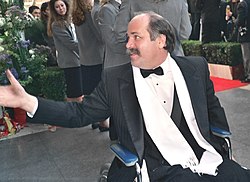
Tom Cruise and Oliver Stone eventually got wind of Ron’s memoir. Their film Born on the Fourth of July became a huge success. When Oliver Stone accepted his Oscar as Best Director, a tuxedoed Ron Kovic looked on from his wheelchair.
Loretta’s documentary, in a Hollywood version of collateral damage, got put on the backest of back burners. Last I heard, she was driving a cab in Chicago.
I never did get to meet Bruce Springsteen.
Dear Mr. Greenhill, Thank you for your wonderful and bittersweet anecdote from your wheelie ride into the inner orbit of the Boss solar system. It is January 2026 and I am writing this merely a day after having consciously read your name and heard your playing for the very first time. This courtesy of shiny, black vinyl LP from 1967 I found in pristine condition a couple of weeks ago: Rosalie Sorrel’s If I Could Be the Rain. (I was merely four years young when your fleet fingers were already accompanying that beautiful voice.) The music stunned me with its grace, musicality, and directness. The LP and sleeve spoke to me with the care and honesty and its striking black-and-white cover photo (my copy still has the liner notes booklet and the postcard). What a treasure. * I love when music finds me, seemingly out of the blue, and breaches the proverbial fortress I have built over the years to protect my creative source and focus. * I am a visual artist, guitar player and composer. I grew up on hard rock and had little interest in folk musicin my youth. It had to be loud, fast, and hard. Playing in a heavy metal garage band in New Jersey was my antidote to the ubiquitous presence of all things Springsteen. In 1978, Darkness on the Edge of Town was just out and all but force-fed to kids like myself, glued to FM radio in the NY metro area. I found the whole thing over-hyped, too popular, too rah-rah. I wanted things raw, fast, and mostly British. Yes, I’d already caught the blues bug, had gone to hear Otis Rush, John Lee Hooker in NYC clubs, and begun my fascination with Jorma’s acoustic playing. (At 19, I thought to myself “when I am an old geezer sitting on a porch I want to be able to play like THAT”) Then I went back to being an art student by day and playing edgy music in dingy venues at night. My regular musical fare consisted of post-punk, Zappa, King Crimson, ECM, Motörhead. And then, seemingly out of left field, comes Nebraska. And everything changed. It opened a door for me. Not just to the dark heart of the American gothic and in its roots music, but to the idea that “I can do this MYSELF in my BEDROOM.” It was revolutionary to me. I could no longer write off Springsteen as fluff. Nebraska seemed to come directly from a world I knew first-hand: driving the Turnpike in the wee hours, feeling alone in the dark with the radio on, watching blinking red lights from radio towers in the distance; having a younger brother who found trouble all too easily. In those songs, I heard a truth that seemed close enough to touch. After that experience, I tried putting lyrics to my own music. But I soon learned that I was more of a sonic explorer than a singer-songwriter. I preferred teaming with singers and still do, to this day. * Fast forward to 2016. I am among a thousand people in line to meet Springsteen at a book signing in Cambridge, MA. I have two hours to meditate on what I might say to him. I am among the first hundred in line and eventually it’s my turn. I am given thirty seconds to shake hands and smile for the camera with him. Mr. Springsteen’s glow and charisma is tangible, his grip firm and warm. I take a deep breath and say, “Thank you for doing what you do.” A Harvard bookstore staffer maneuvers my iPhone and snaps our picture. I take another breath and speak the words I had vowed to get off my chest: “Nebraska was a game changer for me.” His reply makes my day: “Thank you. I really appreciate that.” I step off the little stage, clutching my signed copy of the autobiography, and emerge in to the sunshine outside the bookstore. What a glorious October morning! I felt as if a circle was complete. * By 2016, I had long ago left New Jersey to make my life in Manhattan, Upstate New York, and eventually Maine. My nineteen years in the Garden State had found its bookend with that handshake with Springsteen. * Here we are today and music, beauty, love, and truth are as important as ever for soul survival. It cannot be faked. I can tell the difference and feel enormous gratitude every time. The music you recorded in 1967 with Rosalie Sorrels has that quality. It lives on. It speaks to my truth. THANK YOU FOR THE MUSIC. I look forward to learning a lick or two that you played at 23 to add to my finger-picking arsenal. Because this geezer knows: that front porch is coming closer by the day! — Wishing you a wonderful new year and all the best — With gratitude, Tilman Reitzle